Get the most out of your visit to County Cork’s beautiful Gougane Barra, with history, visit information, and more.

In a valley of the Cork and Kerry mountains, near Ballingeary and Muskerry, you’ll find the incredible Gougane Barra.
Gougane Barra’s historical and cultural significance dates back to at least the sixth century when St Finbarr built a monastery on a lake island. These ties would stretch through hermitages and the Penal Laws and are today celebrated by an annual pilgrimage walk.
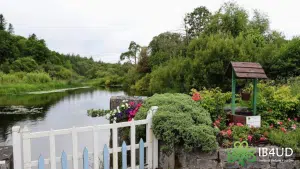
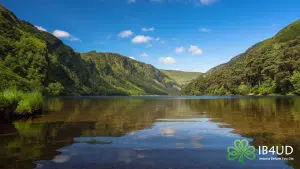
Today, Gougane Barra is a forest park beloved by locals and visitors to the area. It offers an array of walking trails that allow hikers and cyclists to immerse themselves in nature while learning about the area’s rich history.
Ireland Before You Die’s top tips for visiting Gougane Barra:
- Ireland’s weather is notoriously unpredictable, so prepare to face the elements at Gougane Barra regardless of the time of year. On top of weather-appropriate clothing, we recommend wearing comfortable walking shoes during your visit.
- We’ll explore transport options in this article, but the easiest way to reach Gougane Barra is by car. For tips on renting a car in Ireland, consult our handy guide.
- Phone signal may be intermittent, so we recommend downloading any maps you may need in advance and remaining alert to your walking route.
- Dogs are more than welcome in Gougane Barra, so feel free to bring them along!
- Gougane Barra is so close to Cork’s border with Kerry, and some of the best towns in Kerry for a break, like Sneem, Kenmare, and Killarney, are about an hour’s drive away, give or take.
Gougane Barra – a brief history

Tucked away in a valley of the Shehy Mountains that straddle Cork and Kerry, you’ll find the beautiful heritage site of Gougane Barra.
Its name derives from the Irish Guagán Barra, which means ‘the rock-cleft of Barra’, a diminutive of Finbarr, a saint who built a monastery in the valley in the sixth century. Finbarr’s monastery marked the start of Gougane Barra’s long religious significance.
This importance runs through the ruins of a hermitage that exists today – the home of Father Denis O’Mahony, who retreated to the area in 1700 – and through Gougane Barra’s popularity as a place to celebrate mass during the Penal Laws.
There is also an oratory that dates back to the 19th century and marks the end of St Finbarr’s Pilgrim Path, one of five such paths in Ireland.
Gougane Barra underwent reforestation in the late 1930s and now boasts a 1.42 km2 (0.55 mi2) forest comprising 20 species of tree.
Visit info – what you need to know for your visit

Getting there
Getting to Gougane Barra can prove tricky if you don’t have a car. For public transport from Cork City, you should catch Bus Éireann’s 40 services in the direction of Tralee and alight at Ballymakeera. You’ll then have to get a taxi or other private transport to take you the rest of the way.
This bus runs between Rosslare in County Wexford and Tralee in County Kerry, and can also be picked up in towns such as Dungarvan, Youghal, and Killeagh. You can also avail of this service from Killarney and, of course, Tralee, in the opposite direction.
However, as mentioned, the easiest way is by car. There is a car park with ample parking spaces, and access costs €5.
Address: Unnamed Road, Co. Cork, Ireland
READ MORE from IB4UD on what to do and see in the historic Gougane Barra
Walking and cycling trails

As home to the aforementioned St Finbarr’s Pilgrim Path, it should come as no surprise that Gougane Barra Forest Park is perfect for walking or cycling.
The park offers several trails of varying difficulty, ranging from easy walks, like the Slí Doire na Coise, to more challenging ones, like Slí Laoi, and everything in between.
If you’re able, we highly recommend the 11.3 km (7.02 mi) Gougane Barra Loop. Though one of the most challenging walks in the park, it will allow you to explore all the park has to offer, including the famous oratory.
There are toilet facilities scattered throughout the park and plenty of tables for picnics. If you do decide to eat in the park, kindly take all the rubbish with you and leave the area as you found it.
Wildlife

Its vast range of tree species is the first hint that Gougane Barra is a haven for wildlife, but the area is also a perfect place to get up close to some animals.
Indeed, the park is home to several species, such as otters, badgers, foxes, rabbits, wrens, robbins, and herons, among others. Don’t forget your binoculars if you’re a birdwatcher.
RELATED: See where Gougane Barra Forest Park ranks on our list of the 10 best things to do in Cork
Notable mentions

River Lee: The River Lee, which passes through Cork City, has its source near the forest park. The river’s water empties into the Celtic Sea at Cork Harbour after travelling some 90 km (56 mi).
Bantry: Gougane Barra is just a 30-minute drive from Bantry, one of the best towns in West Cork for a break. Some of the town’s highlights include the Bantry House and Garden, Bantry Market, and the Bantry Marina.
Weddings: The small oratory at Gougane Barra is a popular wedding venue, offering couples an incredible setting for tying the knot.
READ MORE: Gougane Barra ranks as the third best hidden gem in County Cork
Your questions answered about Gougane Barra

Don’t worry if you still have questions about Gougane Barra. In this section, we answer some of our readers’ most frequently asked questions on the subject, along with some that appear often in online searches.
Is Gougane Barra worth visiting?
Gougane Barra is a great place to get outdoors. History buffs will love the area’s cultural and historical significance, wildlife lovers will find much to keep themselves occupied, while the active among us will revel in the park’s challenging trails.
What is Gougane Barra famous for?
Gougane Barra is famous for its connection with Irish religious history and culture. It also earns renown for its natural beauty.
How long is the hike in Gougane Barra?
Each of tge trails varies in distance and duration, but the recommended Gougane Barra loop takes three to four hours on average.