Ireland is packed with history and culture. It goes back a long, long time. Hidden within that history is Ireland’s oldest known writing system.
Can you imagine coming across writings from medieval times? Would you be able to read them, though? What did the texts say back then? So many questions – and we have some answers.
We’re looking at the ogham stones, Ireland’s ancient script. They’re like secrets hidden in plain sight. Let’s decipher the past bit by bit and open a door to a world long gone by.
Ogham 101 – from the 4th century
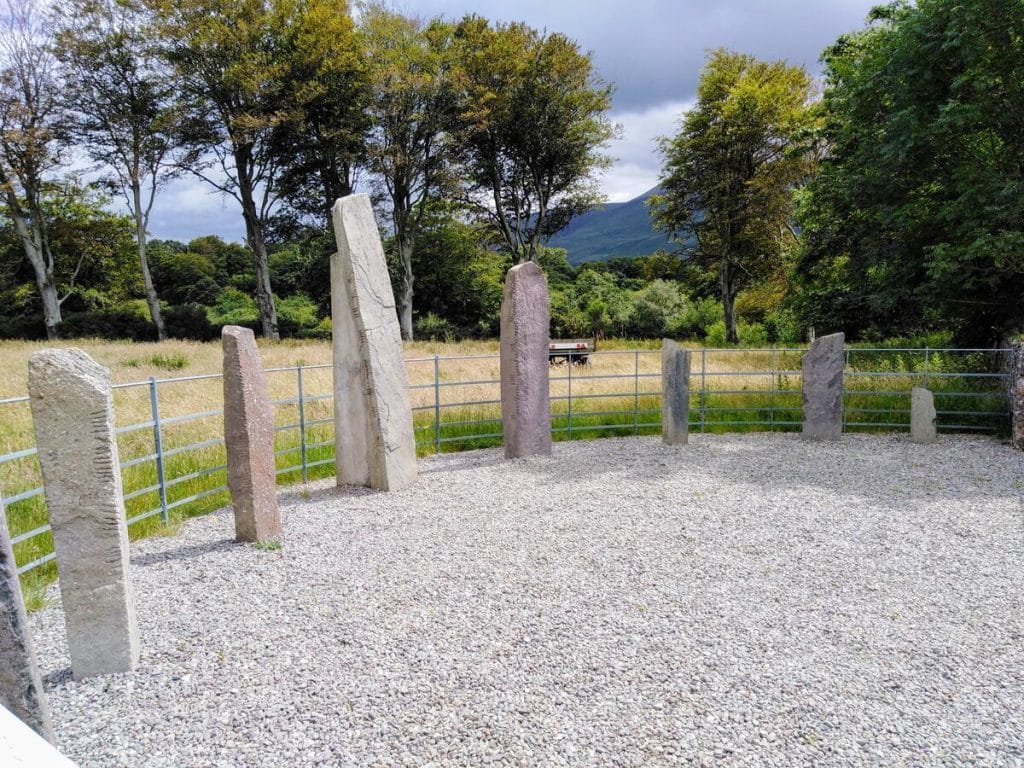
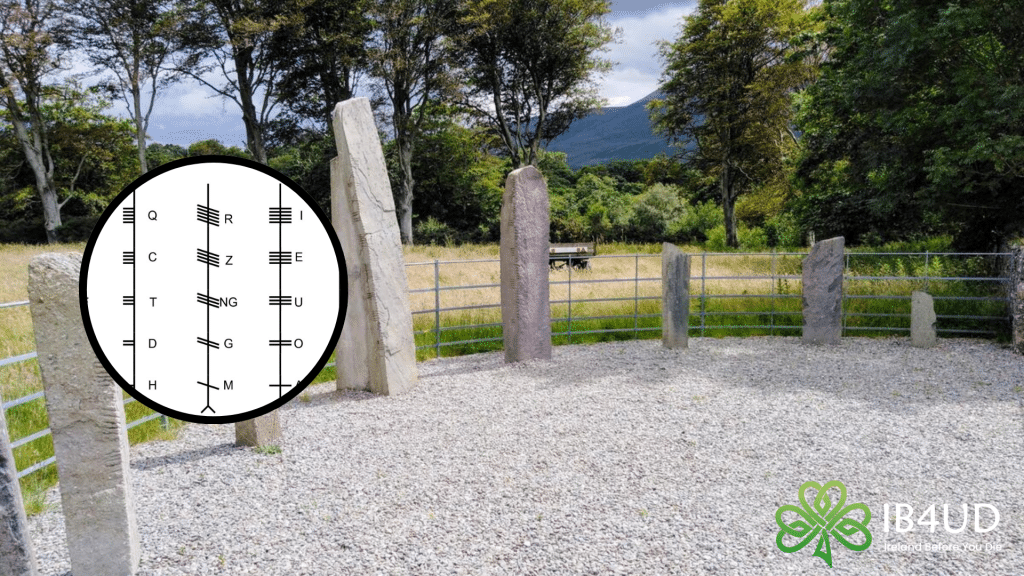
Let’s dive right in: Ogham is a script, an alphabet that was mainly used to write in the Irish language between the 4th and 6th centuries AD, called Primitive Irish. There are still around 400 inscriptions left in Ireland.
These inscriptions are found on stone monuments throughout Ireland and also western Britain, e.g., Wales. Counties Kerry, Cork, and Waterford have the highest number of ogham stones in Ireland.
Most of the texts are inscriptions that follow a standard formula. However, the function of ogham stones is not fully known. Many scholars believe the main purpose could have been burial site markers or also markers for land borders.
Fun fact: In Wales, you usually find bilingual inscriptions – ogham and Latin. So, now that we know what they are, how do we read them?
Who invented it? – legends and stories

There are two stories about who came up with ogham. One legend says that it was invented just after the fall of the Tower of Babel, together with the Gaelic language. That’s credited to Fenius Farsa, the Scythian king.
Another story says Ogma, one of the most notable figures of Irish myths and legends, gave us the script. Ogma was very skilled when it came to poetry and speech. It’s easy to see that connection, isn’t it?
Hidden secrets – it’s in the letters
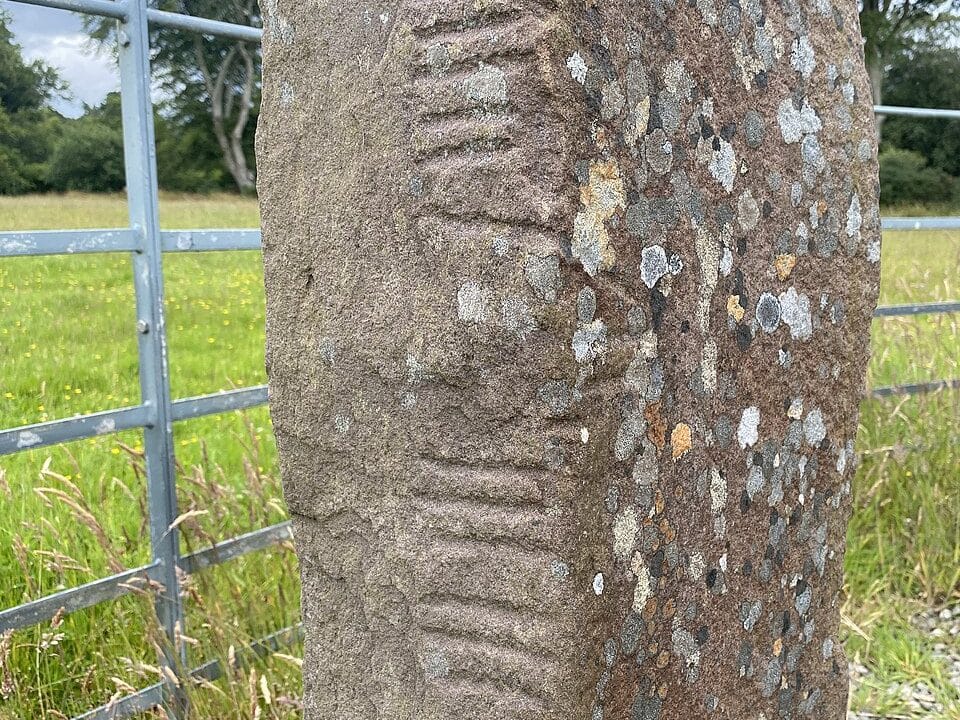
With the language being so old, there are, of course, some unknowns. That’s not all – what’s really interesting is that some ogham letters barely appear in the surviving inscriptions.
That allows for some speculation now, and many scholars believe that ogham may also have been written on materials like wood for a time – materials that didn’t survive. Doesn’t that make it even more fascinating?
It’s also known as the Celtic Tree Alphabet. Why? Many of the letters have names that are related to trees, like the letter B, which is said to be named after the birch tree.
The letters – groups and directions
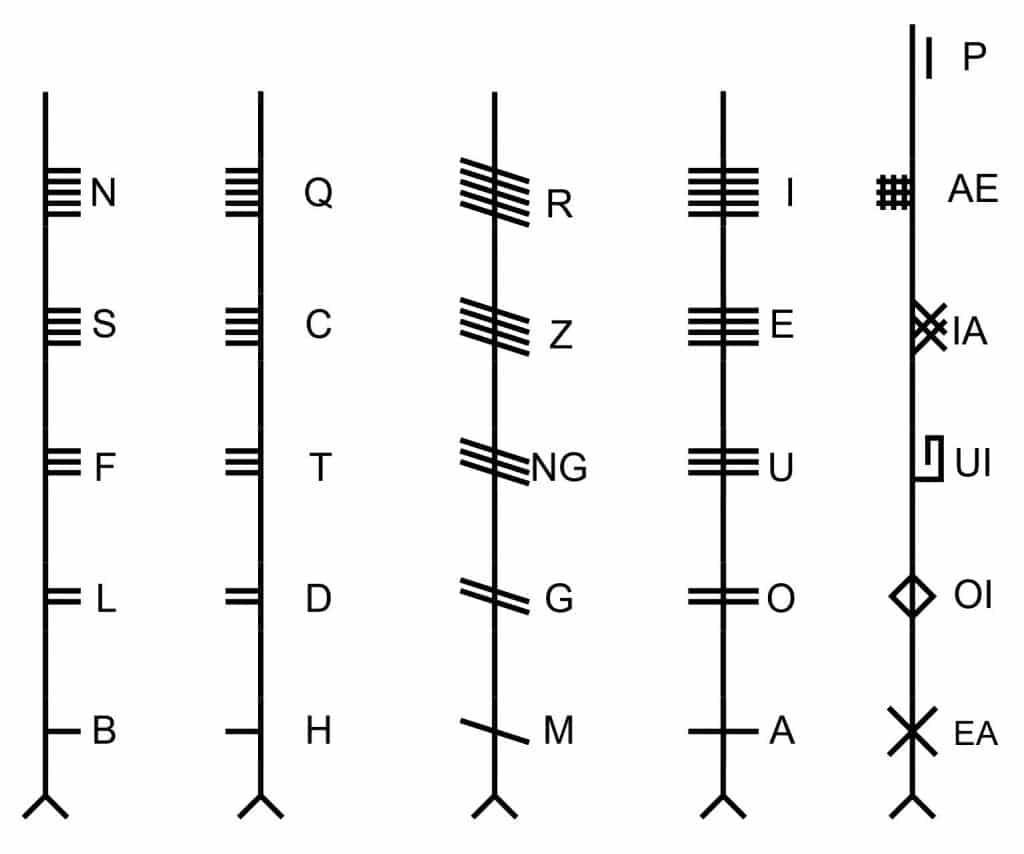
If you were to guess now – does ogham have more or fewer letters than our current alphabet? Or the same number of letters? If you guessed fewer, you’re right. There are originally 20 letters consisting of parallel lines in ogham.
Those 20 letters are divided into four groups. Now bear with us because while it might start to sound a bit complicated, it just gets more interesting. The groups are based on the angle, and direction of the strokes around the line.
Sounds confusing? Give it a sec, it’ll all make sense. So, you have the B group, that’s the right-side strokes. Then there is the H group, left-side strokes.
You also have the M group with the strokes crossing through the line, and lastly, the A group with notches on the line. Later on, five more letters were added.
But how? – find the path
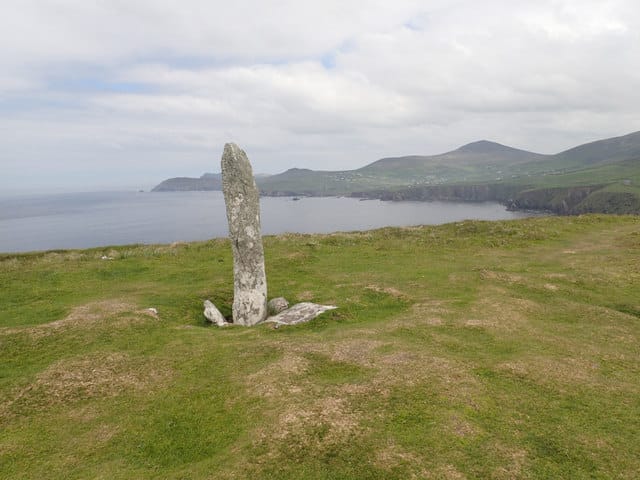
Ogham is focused around a central line. If you’re trying to find that line on a traditional stone, you wouldn’t be able to – it’s not drawn there because the edge of the stone is the line. In a digital version, however, the line is there, and all letters “grow” out of it.
On a traditional standing stone, you’d read ogham from the bottom to the top. For modern texts, the direction is horizontal and from left to right.
The why – what are they hiding?
So how did this language come about? There are actually different theories. Some scholars say it was created as a cryptic alphabet to possibly hide the meaning from writers of the Latin alphabet. Unless you know how to read it, cryptic is pretty accurate.
If that’s the reason for it, any message would have been a secret. The reason behind it was more severe: The threat of a Roman invasion was real, as the Roman Empire had reached Britain. Using ogham as a secret language makes sense, doesn’t it?
The second theory is that ogham was invented by Christian communities in Ireland to have a way of writing short messages in the Irish of the time. It’d have been more difficult to write them with the Latin alphabet.
Both theories make sense, don’t you think? Also, let’s be honest, ogham just looks really cool. Maybe you’ve even come across it before, and you just didn’t notice it. Next time you’re in Ireland, keep your eyes open. Maybe you’ll find it.
Ogham is sometimes used for tattoos. Are you thinking about getting an Irish tattoo? You might find some inspiration in these Irish sayings. What word or sentence would you write in ogham?