From ancient customs to seasonal folklore, help us celebrate this brighter season with our top ten Irish spring traditions.

Ireland is beautiful in spring. Yes, there will no doubt be lots of April showers (how do you think it stays so green?).
However, there’s nothing quite like getting out into the Irish countryside as it starts to awaken once again after a long, cold winter.
Celebrate the return of the lighter half of the year with these Irish spring traditions.
10. Making a St. Brigid’s Cross – an ancient tradition

If you attended a primary school in Ireland, you will most likely have learned to make these beautiful, intricate crosses. St. Brigid is one of the three patron saints of Ireland, and her feast day is 1 February.
Brigid’s crosses are traditionally constructed on this day and hung up above the doorway to bring luck and health in the year ahead.
9. Giving up something for Lent – 40 days of abstinence

Catholicism remains the predominant religion in Ireland, and most of us will remember the whole family ‘giving up’ something for lent.
For children, this typically meant abstaining from sweets, chocolate or fizzy drinks for 40 long days (not including Sundays). But it made digging into Easter eggs all the sweeter come Easter Sunday.
8. Getting your ashes on Ash Wednesday – the start of lent

Ash Wednesday is a holy day for Catholics. All over Ireland, you’ll see people walking around with a black cross of ash painted on their heads.
‘Getting your ashes’ on Ash Wednesday is a common memory for many in Ireland and marks the start of the first day of Lent.
7. Celebrate Imbolc – the Celtic first day of spring

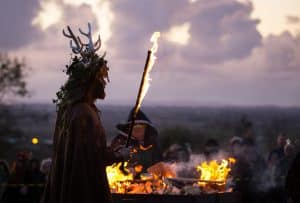
Imbolc is one of the four fire festivals celebrated by ancient Irish people. These days were of great spiritual significance to our ancestors and fell roughly halfway between the solar events of the solstices and the equinox.
Imbolc was celebrated on 1 February (roughly halfway between the winter solstice and the spring equinox) and heralded the coming of spring.
On this day, great fires were erected on hillsides, and feasts were prepared to celebrate the end of the dark days of winter.
This day is also strongly associated with the goddess Brigid, an ancient predecessor to the Christian St. Brigid. One tradition is to open all the doors and windows on Imbolc to ‘let Brigid in’ and bless the house for the coming year.
6. Visiting Loughcrew on the spring equinox – a sacred site

You may have heard about Newgrange, the neolithic burial chamber that is older than Stonehenge and the Egyptian pyramids, but not as many know that another ancient site lies close by.
Unlike its more famous cousin, which is aligned with the sun on the winter solstice, Loughcrew is constructed to align with the spring equinox.
Many people visit the ancient site to celebrate the coming of spring, following in the footsteps of our ancient ancestors.
5. Getting out into nature – reconnecting with the outside world

After months of being bundled up inside by the fireside, spring has always been a time when Irish people get back out into the world.
Ireland is a deeply agricultural society, and with the lambing season in full swing, it can be a busy time spent outdoors.
Use this opportunity to get out into nature to notice the changes you see around you as the world begins to wake up after months of rest.
4. May Eve – when the fairies are near

Another one of the ‘fire festivals’ of the Celtic Irish calendar, ‘Bealtaine’, falls on 1 May (roughly halfway between the Spring Equinox and the Summer Solstice).
The day before Bealtaine (known as ‘May Eve’) was thought to be a deeply magical time when the veils between the human world and the world of the fairies were thin.
As if to make use of the eerie feeling of possibility on this day, a custom developed to collect leaves from the ‘May Tree’ (Hawthorne, or Blackthorne) and throw them over homes and farm buildings.
The purpose of this is to bless and protect the property for the year ahead. This custom still continues in rural parts of Ireland today.
3. Rolling your eggs down a hill – an easter tradition

Egg rolling on Easter Monday is a tradition found in many cultures across Europe, with different variations. But it holds a special place in many Irish people’s hearts.
Traditionally played with boiled eggs (although in recent years, chocolate eggs have taken precedence), the goal is to see whose egg can get to the bottom of a hill first without breaking.
This is one of the Irish spring traditions that has endured.
2. May Day Fairs – an enduring tradition

Ireland has managed to maintain a remarkable number of its ancient (often pagan) traditions, and celebrations like Bealtaine are no exception.
1 May remains an important day in the agricultural society of rural Ireland, with a May Day Fair being held every year on or around this date.
This is a great opportunity for communities to come together. Often, there will be clothes, plants, and farm animals bought and sold.
Although the custom has slowly declined over the years, some towns maintain this long-standing tradition.
1. St Patrick’s Day – celebrating our most famous patron saint

Perhaps the most famous of Irish spring festivals of all, 17 March marks the feast day of Ireland’s most well-known patron saint.
On this day, whole cities are alight with spectacles of green and gold, and parades line the streets just in time for the turning of the weather.
Other customs involve wearing green, attending traditional Irish music sessions, and storytelling (stories involving the leprechaun is a common favourite this time of year)
We hope you enjoyed delving into these Irish spring traditions with us. Whatever this spring has in store for you, it is always comforting to know that brighter days lie ahead.