Escape to one of Ireland’s tranquil, off-the-beaten-track islands.

From lonely rocks way out at sea to islands you can walk to, here’s a countdown of ten great Irish islands that feel a million miles away from your daily 9-to-5 rat race.
10. Inishbofin, Co. Galway – literally, the island of the white cow

No cars on this island; you walk or bike it. But there’s so much here: pristine white-sand beaches, a great Irish trad music scene, award-winning ecotourism and fascinating maritime history.
Notable buildings include Cromwell’s Barracks at the entry to the main harbour, St Colman’s Monastery ruins, and the Pirate Castle where Spanish Pirate Don Pedro Bosco had his base.
According to local folklore, he was closely allied with the infamous Irish pirate Grace O’Malley (Granuaile) to control and tax shipping. This is one of the best Irish islands to visit without the crowds.
Location: About 9 km off the Connemara Coast in County Galway, the west of Ireland.
Perfect for: Walkers and hikers who will appreciate the signposted walks around the island that take in panoramic views, sea stacks, blowholes and monastic sites.
Wildlife enthusiasts for the rare flora and fauna: Inishbofin is one of the last refuges of the corncrake; Families will love the beaches, Irish traditional music lovers for the legendary sessions in Inishbofin House Hotel.
How to get there: This incredibly scenic place is reached by year-round ferry from Cleggan Pier, 15 mins away from Clifden, with extra sailings May through September. Crossing takes about 30 minutes.
Other reasons to visit: Community Arts Festival for May Bank Holiday, the Walking Festival, the High Road Sessions in early July, Bio Bó Finne (Food Festival) in mid-September, as well as several other events.
9. Scattery Island, Co. Clare – won from a sea monster
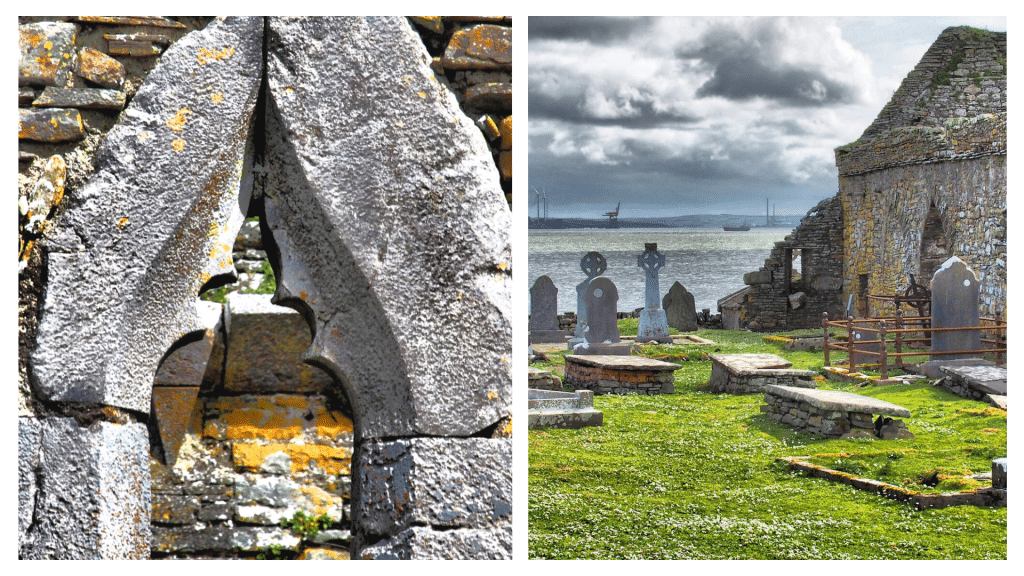
The Scattery Island monastic settlement was founded in the 6th century by Saint Senan, who according to legend defeated a huge sea monster known as the Cathagh to claim the island. The island’s strategic location meant Viking raids in the 9th and 10th centuries, and later a British military artillery battery was constructed during the Napoleonic Wars.
Location: This now uninhabited historic island is in the Shannon Estuary near Kilrush, County Clare.
Perfect for: A day trip for history buffs: The standard two-and-a-half hour tour takes in the Cathedral and mediaeval church ruins including Teampall na Marbh; the 10th century Round Tower, the abandoned famine-era village area; the Lighthouse and Battery, as well as the Visitor centre in the restored local cottage. Scattery Island has toilets and picnic areas but no shops – bring your own lunch, and leave only footprints.
Other reasons to visit: Culture Night on Scattery Island, with blend of history, performance and theatre; National Heritage week mid-August; Annual traditional music revival in early July in Brennan Family Cottage, and Pilgrimage Mass in August.
How to get there: The island open to visitors May to September, accessible by Scattery Island Tours from Kilrush Marina, with booking strongly recommended as sailings are tidal.
8. Inisheer, Co. Galway – “That would be an ecumenical matter.”

If you’re wondering where you’ve seen it before, the smallest and most easterly Aran Island doubles as Craggy Island in the opening credits of the TV satirical comedy Father Ted.
You can get around this Irish-speaking island on foot, by bike or traditional pony and trap. Local landmarks are the 14th century O’Brien Castle built inside older Stone Age fort, the Lighthouse, and St Kevin’s Church, which is dug out of the sand dunes by the locals every year. Plus, the bewildering number of very high stone walls that demarcate the fields.
Location: About 9 km out from Doolin Village in County Clare, and easily seen from the top of the nearby Cliffs of Moher.
Perfect for: walkers, families, history buffs, artists, musicians, poets and lovers of the Irish language as Inisheer is part of the Gaeltacht.
Other reasons to visit: Summer on Inisheer is alive with festivals: Stone Festival Féile na gCloch is on in mid-September; St Kevin’s festival includes outdoor Mass, traditional music and sean-nós dancing; a Bodhrán Summer School is a feature of Craiceann Inish Oírr; excursions to at Aras Éanna Arts Centre on Inisheer are included in the Galway Cartoon Festival, with exhibitions and live sketching in pubs.
How to get there: Inisheer is served by several ferry companies from Doolin (Doolin Ferries, O’Brien Ferries), as well as Galway city (Aran Island Ferries, seasonal) and Rossaveel, or by plane from Connemara Regional Airport near Inverin with Aer Arann.
7. Garinish Island, Co. Cork – the spirit of Italy in West Cork

Garinish features ornate Italian Gardens created in 1910 by the island’s owners Annan and Violet Bryce and Edwardian garden architect Harold Peto. The subtropical microclimate allows the exotic plants to thrive, including rhododendrons of various colours.
Various paths take you through the Italian Garden and Casita with its beautiful reflection pool in front of the Grecian temple, with stone colonnades framing the majestic Caha Mountains, a scene printed on Irish postage stamps for many years.
You’ll also come across a Martello Tower which dates from 1805; and Bryce House, the couple’s original house.
Location: In a sheltered harbour in Bantry Bay close to the town of Glengarriffe in Co. Cork.
Perfect for: Gardeners, botanists, artists, writers, wildlife enthusiasts, families with active youngsters, day trips. Plenty of shade on hot days.
Facilities include: café/restaurant and toilets, no overnight accommodation. Not suitable for strollers or visitors with mobility issues.
Other reasons to visit: Garinish Island home to The Island Drift festival, which blends music, literature, live podcasts and nature, taking place across the island.
How to get there: Garinish is served by two ferries in Glengarriff: the Harbour Queen Ferry and the Blue Pool Ferry. You pay for both the ferry and entry to the island, but it’s worth it. Seals on rocks in the bay are a frequent sight as you make the trip out.
6. Great Blasket, Co. Kerry – the island at the end of the world
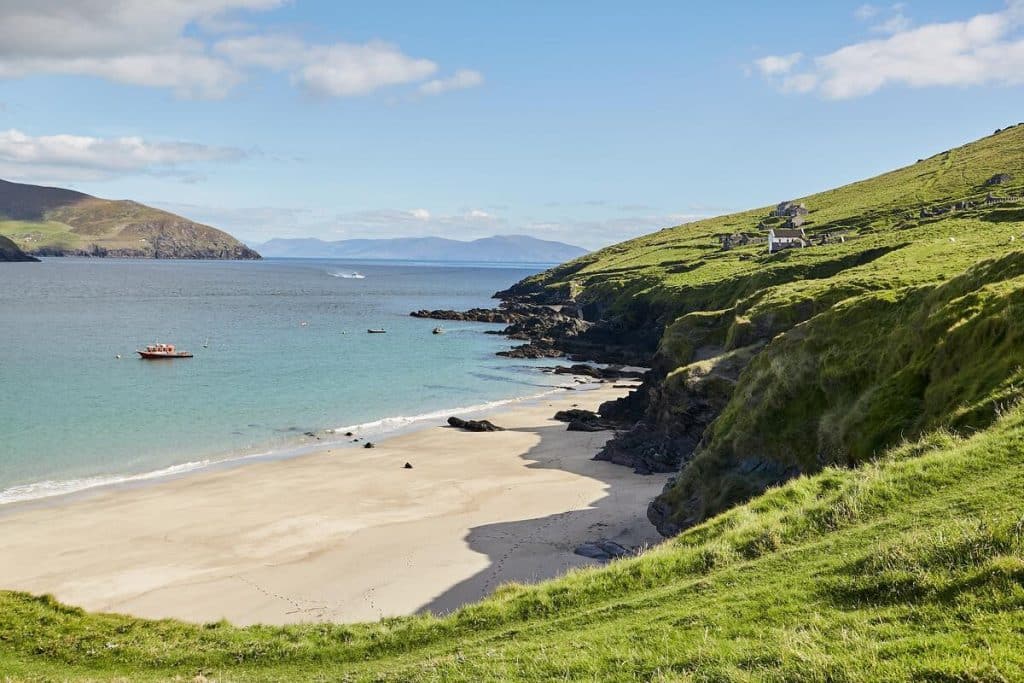
The ruined village was once home to as many as 175 people. The Great Blasket’s isolation was compounded by Atlantic weather and dangerous seas.
However, this isolation preserved a poetically very rich dialect of native Irish and oral storytelling, culminating in great Irish-language literature from three writers from this island:
The Islandman, Twenty Years A-Growing and of course Peig – familiar to every Irish person of a certain age. When life on the Great Blasket became unsustainable in 1953, the island was evacuated.
Location: Off the western end of the Dingle Peninsula, Co. Kerry.
Perfect for: Walkers, wildlife enthusiasts, photographers, artists, poets, families with active youngsters and doomsday preppers, today you can still enjoy the ghost village, the white-sand beach with its huge seal colony, and encounter island sheep roaming free, with great views from the top of the island over the nearby Sleeping Giant (Inis Tuaisceart).
Accommodation and facilities: You can rent one of three off-grid eco-cottages through Great Blasket Island Experience and there’s a cultural heritage space with a café nearby. Bring all your own provisions on the boat, and book early as these cottages are extremely popular.
How to get there: Blasket Island Ferries and The Blasket Ferry operate from Dunquin Pier, while Dingle Boat Tours/Dingle Bay Charters operate from Dingle Town Marina and from Ventry: Blasket Islands Marine Tours. The crossing from Dunquin takes about 20 minutes, please note that you’ll need to transfer to a dinghy to get onto the island.
5. Great Saltee, Co. Wexford – the great wildlife sanctuary in the south-east

The Great Saltee has been privately owned by Neale family since 1943 and they the one house on the island. Otherwise there are NO amenities here, so you bring your own food and water and remove your rubbish when you leave.
But the wildlife is worth it: there are puffins in May/June, as well as gannets, kittiwakes, guillemots and razorbills, and grey seals in the coves. Historically the Great Saltee was a base for pirates, smugglers and buccaneers, and there’s even a ‘throne’ where you can be ‘king’ of the island for a few minutes.
It’s a great place to visit, but on a hot clear day, make sure to bring a hat, sunscreen and plenty of water as there are very few trees.
Location: Off the coast of County Wexford in the south-east of Ireland.
Perfect for: Walkers, wildlife enthusiasts, photographers, artists, families with active youngsters, nature lovers.
How to get there: This spectacular wildlife sanctuary is accessible by boat from Kilmore Quay, operated by the Three Sisters Cruise Company. Visitors are welcome between 11 am and 4.30 pm only, April through August, and please note that there is no pier, it’s a wet landing with no paved paths and therefore not suitable for strollers or for those with mobility issues, and no dogs allowed.
4. Coney Island, Co. Sligo – Ireland’s most famous tidal island

Locals say New York Coney Island in the US was named after the Sligo island by a Sligo ship captain, while the island in Sligo itself was named for its huge rabbit population.
M.J. Ward’s is the only pub on the island, run by the McGowan family who have lived here since the 1750s and are the only remaining full-time inhabitants.
The island has beautiful secluded beaches (Carty’s Strand), fairy forts, St Patrick’s Well and Wishing Chair. Sligo Bay is stunning, the landscape dominated by majestic Benbulben mountain.
Location: at the mouth of Sligo Bay in the north-west of Ireland.
Perfect for: walkers, adventurers, runners, families, artists, photographers, musicians, poets and dreamers.
Other reasons to visit: Coney Island is part of annual Wild Atlantic Shanty Festival, with music in MJ Ward’s, and proceeds go to Sligo Bay RNLI Lifeboat station. Also of interest is the Coney Island Adventure Run held in late June, to raise funds for Sligo Rugby Football Club. Look out for one-off festivals that involve Coney Island itself and the causeway.
Accommodation and food: Michael J. Ward’s Pub opens seasonally, and is also subject to tides – check the link for information. Overnight stays are possible at Inishmulcloly Lodge and through Air BnB. Get your booking in early.
How to get there: This tidal island is accessible by car or on foot at low tide only, with the 2.4 km/1.5-mile-long causeway route marked by 14 massive stone pillars, from Cummeen Strand on the mainland. A water taxi is also available from Rosses Point. Always check tides by texting 51155 within ROI to receive real-time safe crossing windows from RNLI.
3. Dursey Island, Co. Cork – served by Ireland’s only cable car

Dursey is connected to mainland by the only cable car in Ireland, and is one of a handful in Europe to operate over open water.
Once you’re on the island, it’s walking only; and you bring your own food and water. There are no trees either, but there are spectacular views, especially from the hilltops. Dursey is a looped section of the famous 206-km-long Béara Way Trail.
You’ll pass Kilmichael Church, now a ruin, founded by monks from Skellig Rock. The Napoleonic Signal tower dominates the island’s centre, and Dursey Head, 6.5 km from the cable car, has panoramic views of Mizen and Sheeps Head to the east and the Ring of Kerry to the west, and the Bull, Cow and Calf islands out to sea.
Look out for seals and dolphins, and birds nesting in cliffs. Make sure to leave yourself plenty of time to get back for the last cable car crossing at 7.30pm.
Location: The very end of the Béara Peninsula in the south-west of Ireland.
Perfect for: Hikers and walkers, artists, photographers, nature lovers, history buffs, dreamers and families with active youngsters.
Accommodation and facilities: on the mainland only.
Other reasons for visiting: Dursey Island Summer Festival takes place in mid-June with community barbecues, storytelling sessions, poetry readings, and community games. There’s also a free guided history walk on the Sunday and live traditional music in the open air. Many locals set up cake and snack stalls to provide refreshments, with all funds raised donated to nearby Castletownbere RNLI Lifeboat Stations.
How to get there: Cable car crossing takes 8 minutes, and the cable car operates on a first-come, first-served basis between 9.30 am to 7.30 pm, with a half-hour lunch break at 1 pm.
2. Skellig Michael, Co. Kerry – the tiny rock far, far away

This island is home to a UNESCO World Heritage Site, a 6th century monastic settlement with dry-stone beehive huts located 12 km from the mainland.
Skellig Michael is a wildlife sanctuary, so visits here are restricted: landing tours are limited to 180 visitors per day, mid-May to end September only, and rates start at €145 per person.
Note this is BEFORE you have to climb 618 rough stone steps to the monastery, with NO handrails. Demand is high, so tours to Skellig Michael are often booked up well in advance.
However, eco-tours around islands and coastline are also possible. Bring your own snacks and water, leave only footprints.
Perfect for: Star Wars nerds fans, history buffs, photographers, dreamers, poets. No children under the age of 12 (check specific terms with individual boat operators).
How to get there: Most boats leave from Portmagee Marina (Casey Skellig Islands Tours, Skellig Rock Cruises), and it takes 45 minutes to reach Skellig Michael, depending on sea conditions. There are other sailings from Derrynane Pier. Proper walking shoes or boots are required.
1. The Bull, the Cow and the Calf, Co. Cork – a gateway to the Underworld

Home to massive sea bird colonies, these islands are also steeped in history, legend and folklore. Calf Rock, the furthest away from the mainland, was once the site of a cast-iron lighthouse built in 1866, but was snapped in half and pulled into the sea during a huge storm in 1881.
The keepers miraculously survived in the remaining stone base for 2 weeks before their rescue. You can still see the ruined stump of the lighthouse.
Cow Rock, located between the other two, is flanked by beautiful wave-carved sea arches, and its cliffs are vital nesting grounds for migratory birds. Bull Rock, the closest to the mainland, is home to a now fully automated lighthouse, but people once actually lived out here to operate the lighthouse. Today it is inhabited by a huge colony of gannets.
Bull Rock is 93 metres high with a naturally formed sea arch through its centre, known as the ‘Gateway to the Underworld’.
Location: These three volcanic rocks stick out of the ocean just off the end of Dursey Island, Co. Cork.
Perfect for: Wannabe smugglers, buccaneers and pirates, adventurers, history buffs, lovers of all things maritime.
How to get there: These islands are inaccessible and can only be viewed from the water or from the end of Dursey Island. You can, however, visit them by Sea Safari with Dursey Boat Trips which depart from nearby Garnish Pier on the mainland between April and September. If you’re very lucky and the sea is calm enough, you’ll get to sail through the Gateway to the Underworld.