From 16th-century pub classics to modern live streams, Ireland’s love of card games has evolved with the times while keeping its social spirit at heart.

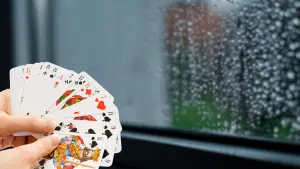
Card games in Ireland did not arrive with flashing lights or casino carpets. They came quietly. A deck of cards slipped from a pocket. A table cleared after dinner. A few coins pushed into the middle “just to make it interesting”.
By the 16th century, Spoil Five, known locally as Twenty-Five, had become one of Ireland’s most popular card games. It is widely regarded as Ireland’s national card game, particularly in counties like Cork and Kerry where it still thrives in pubs and parish halls.
The rules are simple enough to learn and difficult enough to master. Perfect pub material.
Other imported games filtered in over time. Variations of Rummy became household staples. Whist, and later bridge, found their own audiences. Long before television dominated the evening, a deck of cards was more than enough.
No screens. No Wi-Fi. Just shuffling, quiet concentration, and someone insisting they “knew rightly you had the ace”.
In taverns in Dublin or around kitchen tables in Limerick, cards were less about gambling and more about gathering. Tea or pints. Sandwiches appearing halfway through. Stories stretching longer than the game itself. Cards were social glue.
The rise of organised poker – Ireland enters the tournament era

Informal wagering had always existed. A few pound coins on the side. Nothing headline-worthy. However, poker in its modern competitive form arrived much later than many assume.
While Texas Hold’em was developed in Texas in the early 20th century and popularised in Las Vegas during the 1960s and 1970s, its deeper roots stretch further back.
Historians trace early models of poker to 19th-century riverboat games in the United States, influenced by older European card traditions.
In Ireland, the modern poker scene took shape in 1980, when bookmaker Terry Rogers launched the first Irish Poker Open in Dublin.
What began as a bold experiment soon developed into one of Europe’s longest-running poker tournaments. By the mid-1980s, Ireland had secured a respected place on the international poker circuit.
Blackjack also became associated with Ireland’s modest but steady casino scene. Unlike some European countries, Ireland never developed a vast network of state-licensed casinos.
Instead, private members’ clubs operated within legal frameworks shaped largely by the Gaming and Lotteries Act 1956 and subsequent amendments.
The glamour of Las Vegas never fully landed here. Ireland’s version was more understated. More familiar. Less neon, more nod-and-wink.
The digital boom – from felt tables to fibre optic

The biggest shift did not happen in a casino. It happened at home. In the early 2000s, as broadband expanded and smartphones became part of daily life, card games entered a new phase.
Online poker rooms grew rapidly after Chris Moneymaker’s 2003 World Series of Poker win, a moment often credited with fuelling a global poker boom. Irish players were part of that surge.
Suddenly, there was no need to travel into town. You could simply log in.
Platforms offering live poker online began streaming real dealers in real time. Poker tables ran around the clock. Blackjack was available at the tap of a screen. New variations and live studio formats were introduced to mirror the feel of physical tables.
What changed most was not the rules. It was the setting. A player in Galway could join a table hosted abroad. Someone in Belfast could play a quick hand between meetings. The table became global.
The classics that never left – solitaire and beyond

Not every card game in Ireland revolves around competition. Digital versions of Solitaire, FreeCell, and Hearts have remained among the most played games on personal computers for decades.
For many, their first introduction to card strategy was not in a pub but on a Windows desktop during a lunch break.
Yet, for all the technological changes, the fundamentals remain much the same. Bluffing still works. Luck still swings wildly. Someone still insists they “would have won that hand if…”
Pub poker nights have not disappeared either. In parts of rural Ireland, Twenty-Five tournaments continue to draw steady crowds. Charity poker nights fill community halls. The shuffle of real cards still carries weight.
From fireside games in the 1500s to fibre-optic live streams in the 2020s, Ireland has not abandoned its card-playing tradition. It has simply adapted it.
If you listen closely in any pub on a quiet evening, you will probably still hear it.Shuffle. Tap. Deal.
Legal Disclaimer
We cover articles relating to many activities. Some of our articles showcase gaming and gambling as activities. While we do not take money for bets or own any gambling venues, we feel it is important that our readers know the risks of such venues or sites that we may mention in our articles. Gambling involves risk. Please only gamble with funds that you can comfortably afford to lose. See our legal disclaimer for more info.