The land of saints and scholars, revolutionaries and rebels, it’s no wonder Ireland has its fair share of tragic love stories.

As a nation fraught with civil wars, political tensions, and more, Ireland over the past several centuries has seen a number of devastating love stories bloom and die.
From the country’s poets and their desires to be loved, to Irish revolutionaries and their last ditch efforts to be with the one they love, here are the five most heartbreaking love stories in Irish history.
5. William Butler Yeats and Maud Gonne – a tale of unrequited love
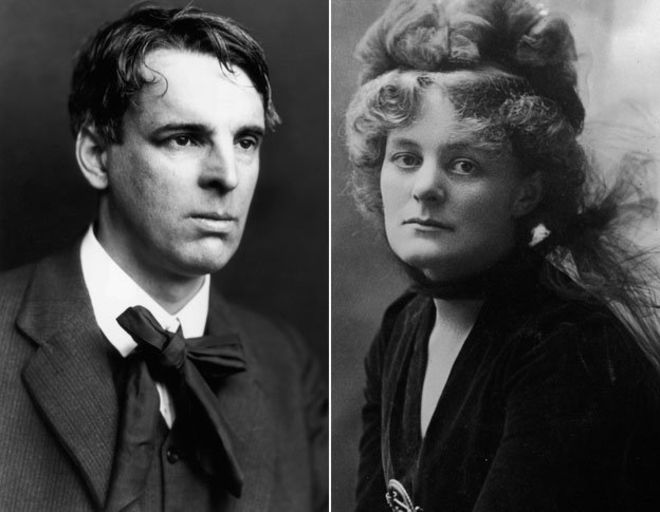
William B. Yeats is considered far and wide one of the greatest literary icons Ireland has ever produced.
Many poems of his, including “No Second Troy” and “When You Are Old”, were inspired by his greatest love, English-born Irish revolutionary Maud Gonne.
Their love story was entirely one sided on the part of Yeats. He proposed to Gonne several times over their failed courtship, and Yeats was shattered when Gonne went on to marry Irish nationalist John MacBride in 1903.
After that marriage failed, Yeats proposed to Gonne again, but still she said no. In 1917, Yeats proposed, quite inappropriately, the Maud Gonne’s daughter Iseult.
Although she was 22 years old at the time, Yeats had known her since she was a child. Where that guy who runs through fields with the giant red flag when you need him?
In the end, while Maud Gonne remained Yeats’ ultimate muse, there was never a romantic relationship. However, they remained close friends until Yeats’ death in 1939.
4. Oscar Wilde and Alfred Douglas – interference of outside voices

Considering homosexuality was only decriminalised in Ireland in 1993, and same-sex marriage was made legal just over ten years ago at the time of writing this article, we can only imagine how difficult it was for same-sex relationships in 19th century Ireland and England.
Oscar Wilde and Alfred Douglas met in London in 1891 when Wilde was already a famous writer and Douglas was a student at Oxford University.
This is one of the most heartbreaking love stories from Irish history because from the get go, outside voices interfered, interjected, and disagreed with their relationship.
Douglas’ father, the Marquess of Queensberry, tried to publicly shame Wilde, accusing him of homosexuality, which was illegal at the time and punishable by a prison sentence.
Wilde tried to deny the claims made by Douglas’ father, but was ultimately found guilty and ended up serving two years of hard labour between 1895 and 1897 for “public indecency”.
After he was released, he caught an overnight steam train to France, and never returned to England or Ireland. Douglas met him out in France that same year, but intervention from friends and family meant the relationship could never work.
While living out the short remainder of his life in France before his death in 1900, he wrote his final work, The Ballad of Reading Gaol. This was certainly one of the top Irish love stories of all time.
3. Michael Collins and Kitty Kiernan – love triangles, love letters, and ultimate heartbreak

If it’s not Irish literary heroes, it’s Irish revolutionaries when it comes to the saddest love stories in Irish history.
Everyone will know that Michael Collins was one of Ireland’s most famous revolutionary heroes. Collins first met Kitty Kiernan while he was staying at her family’s hotel, The Greville Arms Hotel, in County Longford.
As with any great and tragic love story, there were several other people involved in this courtship. Initially, Michael Collins vied for the affection of Kitty’s sister Helen, who was already engaged to someone else.
To complicate matters further, after Collins turned his affections to Kitty, a love triangle ensued as Collins’ friend and fellow revolutionary, Harry Boland, was also quite taken with her.
Kitty ultimately chose Collins, something she declared in one of hundred of letters the pair exchanged over the course of their relationship, due to distance being common with Collins’ position.
They got engaged in late 1921 during the Anglo-Irish Treaty negotiations, with plans to marry at the end of 1922. These plans would be foiled by the ambush that killed Michael Collins in August the same year.
2. Charles Stewart Parnell and Kitty O’Shea – scandal and a sad ending

Charles Stewart Parnell is rememered as the leader of the fight for Irish Home Rule and land reform in the late 19th century, a key figure in shaping modern Irish nationalism.
Parnell met Kitty O’Shea in the summer of 1880 at the Palace Yard at Westminster, as she wanted to arrange a meeting between Parnell and her husband, Captain William O’Shea.
The pair would go on to have an affair that lasted ten years. William O’Shea discovered his wifes infidelity, and challenged Parnell to a duel in 1881.
The affair become an open secret around London, but O’Shea kept quiet on it, apparently in the hopes of earning an inheritance from Kitty’s wealthy aunt.
When the affair came to light, Victorian England and Catholic Ireland were outraged in unison, and it had the power to destroy Parnell’s career, shatter the Irish Paramilitary Party, and completely derail the movement for Irish Home Rule.
Charles Parnell did get to marry Kitty O’Shea in the end, though, but he died just three months later.
1. Grace Gifford and Joseph Mary Plunkett – the saddest love story in Irish history

You’ll never read about the tragic story of Grace Gifford and Joseph Mary Plunkett and not be saddened by it all.
Grace Gifford, who was a talented artist and caricaturist, met Joseph Mary Plunkett, a poet, journalist, and key Irish revolutionary, in 1913 through the literary magazine Plunkett edited, The Irish Review.
Over the next two years, the pair would bond over art, Irish culture, and nationalist ideas, and eventually got engaged in Decemeber 1915.
Joseph Mary Plunkett was one of the seven leaders of the April 1916 Easter Rising. For his part in the rebellion, Plunkett was court-martialed, convicted of treason, and sentenced to imminent death by a British firing squad.
Knowing death was close, he asked if he could marry the love of his life beforehand. This was granted, and Grace ran to a jeweller on Grafton Street to get a wedding ring.
At Kilmainham Gaol on 3 May 1916, Grace was led to the candelit chapel, where Plunkett was brought down from his cell. The story goes that the pair weren’t allowed to speak to each other during the ceremony, except to respond to the the vows.
After the quick, heavily supervised ceremony, they were allowed a few moments together under supervision, after which, Grace was led away, and Plunkett was executed the following morning.