Feel your knees buckle with fear at these haunting places in Ireland.

Everyone loves a good ghost story. Something that will worm its way in through your ear and send shivers beneath your skin.
Ireland is full of such stories to keep you up at night. From abbeys to hotels, to gaols and workhouses, there are haunted places throughout Ireland with some seriously dark histories.
No one remembers the story of the manor where the family lived happily together after all. No. They remember the places where violence and trauma bled through to the other world. Calling forth restless spirits into ours.
Here are ten of the most haunted places in Ireland with seriously dark histories. Readers beware past this point.
10. Shelbourne Hotel, Dublin – an unwelcomed visitor in the night

An icon of Irish hospitality on the edge of St. Stephen’s Green, Shelbourne Hotel hosts many visitors during their stay in Ireland. Yet, the location is stepped in a rich history many are not familiar with. For not only was it the workplace for Alois Hitler Junior, Adolf Hitler’s half brother.
It is also speculated to be haunted by a young cholera victim. Mary Masters. Who died in 1791, but is still reportedly seen wandering the halls by guests and staff to this day.
Amidst the luxury rooms of the hotel, room 526, or 256 by some tellings is said to be the favourite haunt of the young ghost.
Actress Lily Collins famously shared her encounter with the spirit during a night spent in room 255. Reports even spike as high as 2-3 times a week during certain periods.
At the heart of the sightings and mystery though is a question. Why is little Mary Masters still there? And what keeps her restless spirit up at night, unable to rest?
Address: 27 St Stephen’s Green, Dublin, D02 K224
9. Abbey of the Black Hag, Co. Limerick – sins buried to time

Knuckled in a rural valley in County Limerick is the Abbey of the Black Hag. Known originally as St. Catherine’s Augustinian Abbey. The location dates back to at least 1298, where it is mentioned in its earliest written record. Making it one of Ireland’s oldest medieval convents.
The dark history of the site would begin in the 15th. Where the Earl of Desmonds and his wife, the Countess Desmond, would flee to safety during a blood-feud with the Butlers.
The Countess would be wounded by an arrow, and laid to rest in the convent’s ground. Only for it to be found later that she had been buried alive.
Her screams have haunted this Irish place ever since, but did not give the Abbey of the Black Hag its name. No. The name came from a nun believed to have turned her back to God in pursuit of darker desires.
Said to have left a persistent mark of darkness behind her, the site has been abandoned since the dissolution of the convent in the 16th century. All that remains are ruins. And the disquieting sound of muffled screams still reported to this day.
Address: HWCP+GQ, Oldabbey, Greenville, Co. Limerick
8. St. Brigid’s Psychiatric Hospital, Co. Galway – what is the difference between institutionalization and incarceration?

Opening in 1833, the St. Brigid’s Psychiatric Hospital was one of the earliest institutional district asylums in Ireland. In a short amount of time, the institute would suffer from overcrowding and overpopulation within its doors until as late as the 1950s.
With the deinstitutionalisation of mental health starting from the 1980s, the purpose of such an abhorrent institute would slowly see a decline until St. Brigid’s eventually closed in 2013.
Although not a location where traditional hauntings of spirits occur. St Brigid’s is a location haunted by the memory of what it once was and the systems it supported. Institutes like it were hardly about the rehabilitation of the most vulnerable of society.
But rather the incarceration of those deemed undesirable or difficult to the powers of the time. St Brigid’s sadly is not a haunted memory of a practice we no longer continue. But sadly what that practice once looked like in history.
Address: Church St, Townparks, Ballinasloe, Co. Galway
7. St Columb’s Cathedral, Co. Derry – do not disturb the dead

Baked into the stones of St. Columb’s Cathedral is violence. Early records of the church illustrate its involvement in the Nine Years War. The site would suffer damage during its use as gunpowder storage, resulting in an accidental explosion.
Following this, Sir Henry Dowcra would tear down the church following his successful siege of Derry. Using the remains of the church in the construction of the city’s walls and ramparts. Near the original site a new church would be built in 1633.
In 1867 the bones of a former bishop, William Higgins, would be disturbed following renovations to the church. Since then, footsteps can be heard crossing locked galleries. And the organ can be hear playing, even when no one is in the building.
Accounts of the spectre are most common during periods where grief and anger are high. The emotions seemingly drawing the spirit towards. Brining with it an ominous sense of dread.
Address: 17 London St, Derry BT48 6RQ, United Kingdom
6. Crumlin Road Gaol, Belfast – sentenced to death behind bars
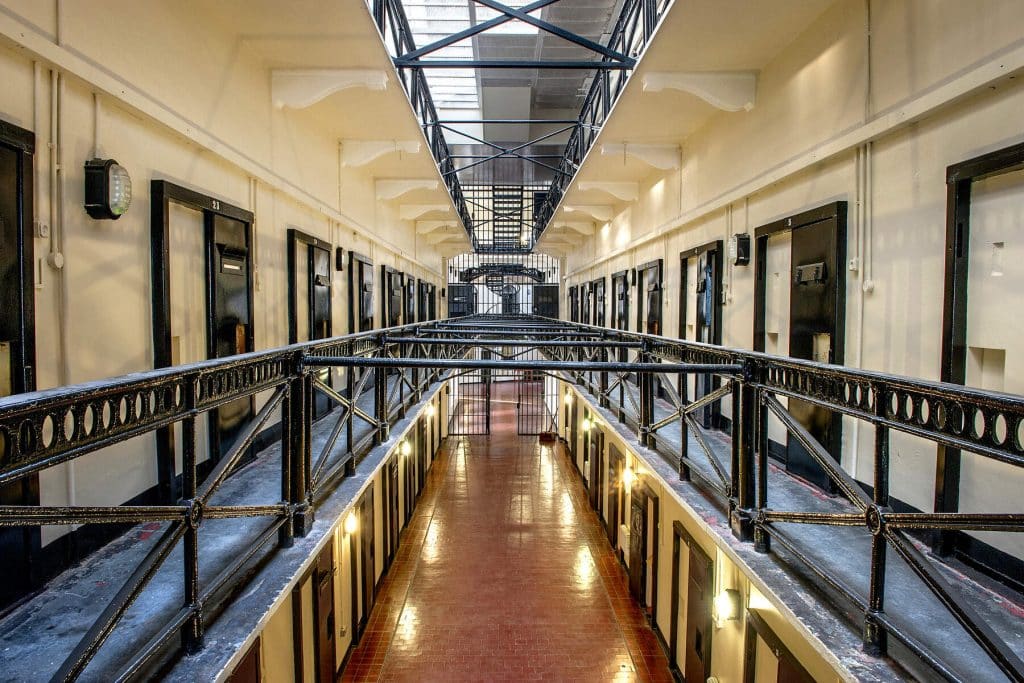
First opening its doors in 1845, Crumlin Road Gaol is one of the most notorious prisons built in Northern Ireland. From its opening until its closure in 1996, the gaol is a dark site in history for the violence which occurred within its walls.
Now a popular tourist destination and event site, the public image of the gaol has changed greatly from the days when it was still operational. However, the echoes of violence and torture which once pervaded the walls of the gaol are not so easily washed away.
Ghostly apparitions and unexplained occurrences are commonly reported on. Women, children, and political opposition were all made prisoners over the period of the gaol’s operation. Many would never leave the gaol.
As even in death after visiting the hangman’s noose, prisoners would still not be allowed to leave. Their bodies never return to their families and loved ones. Buried an unmarked grave within the confines of the prison. Trapped in death as they were in life.
Address: 53-55 Crumlin Rd, Belfast BT14 6ST, United Kingdom
5. Kilkenny Union Workhouse, Co. Kilkenny – a mass grave forgotten to time

Following the establishment of the 1838 Ireland Poor Relief Act, the Kilkenny Union Workhouse would complete its construction in 1842. The fifth-largest warehouse built in Ireland at the time, it was originally built with an occupation of 1300 people in mind.
However, not long after its construction, the Great Famine would arrive. Stressing the infrastructure of the workhouse, where by 1851 there would be over 4300 occupants inside.
The only greater mystery to how the workhouse supported so many people is how a mass grave of nearly 1000 people was discovered only 20 years ago. Over 150 years since the establishment of the institution.
Those invested into the earth beneath the workhouse had been buried between August 1847 and March 1851. A place meant to help the poor would simply become one where many would wait to die.
Their names and history are unremembered. Only recently given release from their entombment after so many years of choking on the dirt.
Address: The Workhouse, Prologue, Callan, Co. Kilkenny, R95 KC95
4. St. Michan’s Church, Dublin – Ireland’s vandalised mummies

St. Michan’s Church is an old place. Older than many realise with its foundations stretching back to 1095 as the site of a Norse chapel.
This makes it one of the few buildings in Dublin to have a surviving Viking foundation. This age has resulted in peculiar traits attaching themselves to the building.
Most notably, the mummified remains of several people. Including a nun who died 400 years ago and a man believed to have been a crusader in life. The means through which the bodies became mummified is fascinating. Lending the church an eerie feeling as to what else slumbers within.
However, not everyone is content to let the dead rest. In 1996, a fire was started in the crypts, damaging countless remains. And in 2019, a burglar damaged several bodies while taking the head and skull of the crusader.
Although the remains were later found, reports speak of whispers coming from around dark corners, or leathery hands brushing against visitors to the crypt. Perhaps the mummies, having been desiccated too many times, simply wish to be left alone?
Address: Church St, Arran Quay, Dublin 7, D07 F3P6
3. Skibbereen Famine Graveyard, Co. Cork – not enough graves to go around

One of Ireland’s largest mass graves, Skibbereen is an emotional place for many. One of the hardest hit places in Ireland during the Great Famine. It was once a hub of commerce were trade flowed in the south of Ireland.
When people started dying, they did so faster than those alive could afford to take care of the dead.
Hence, a mass grave was dug, were the coffinless and nameless bodies of between 8,000 – 10,000 people were buried between 1845-48. When all had settled, 1/3 of Skibbereen’s population was dead.
The scar of this period is still seen in the land today at the Abbeystrewery Cemetery. Where tombstones from many different periods of time can be seen. Stood beside an empty plot of green field where the unremembered still remain.
Address: N71, Abbeystrowry, Co. Cork
2. The Hellfire Club, Dublin – a rather strange thing

Sat ominously on Montpellier Hill, looking out onto the city of Dublin is the ruins of the Connolly Hunting Lodge. The speculated meeting place for the Hellfire Club. The organisation dates back to 1735.
With the founding member of Richard Parsons gathering likeminded aristocrats to partake in excesses only the wealthy could afford to partake in. Wrapped in the pretence of a gathering of enlightened individuals.
These meetings were little more than gross displays of excess and debauchery by the club’s members. With the excesses would resulting in assault and even murder before even touching the rumoured occult practices.
Deals with the devil and Satanic rituals were commonly reported by locals and authorities at the time, causing an indelible stain to linger all these centuries later after the club was disbanded.
Strange noises and sounds are said to come from the ruins and it’s considered one of Ireland’s most haunted places.
Address: Mountpelier, Co. Dublin
1. Kilmainham Gaol, Dublin – a fight against oppression and suffering

One of the largest unoccupied prisons in Europe and a museum towards Irish nationalism, Kilmainham Gaol has undergone much evolution since opening in 1796. However, reclamation sadly does not undo the harm caused throughout its operation.
Men, women, and children were forced into cells together and forced to live in squalid conditions, many who would end up confined in the prison would die there. Kilmainham was the final resting place of many Irish leaders and revolutionaries.
The legacy of the Irish struggle for independence lives on through the walls and memories of the place. With the stories of political imprisonment, rebellion, and execution being too many to count.
Once seen as a site of oppression and suffering for the Irish people, the site has been reclaimed and refitted to tell a new narrative. One that gives power back to those that had been imprisoned there. Allowing them to speak with voices that are more than haunted echoes.
Address: Inchicore Rd, Kilmainham, Dublin 8, Dublin