
Discover Inishowen’s best-known monument, Grianán of Aileach, a true gem in the crown of County Donegal.

The history of Ireland isn’t just recent and within reach; it is distant, far, almost alien, and certainly ancient. Grianán of Aileach embodies this.
Built back in 1700 BC, you can re-enact the life of the local chieftains once you reach the summit of the stone fort and gaze over the Donegal countryside and the waters that bound the Inishowen Peninsula.
Undoubtedly one of Donegal’s finest historical achievements, read on to discover all you need to know about Grianán of Aileach.
Interesting facts about Grianán of Aileach:
- It is believed that Grianán of AIleach was constructed around 1700 BC, serving as the seat of the Uí Néill dynasty.
- The stone fort is built of three terraced earthen banks and dry-stone walls. These were built without mortar.
- Excavations have demonstrated evidence of human habitation going back millennia. Discoveries included prehistoric artefacts.
- The stone fort offers stunning views of Lough Swilly in County Donegal, as well as Lough Foyle and the Derry and Donegal countryside.
- Today, Grianán of Aileach hosts Irish cultural events and music festivals.
History of Grianán of Aileach – prehistoric origins
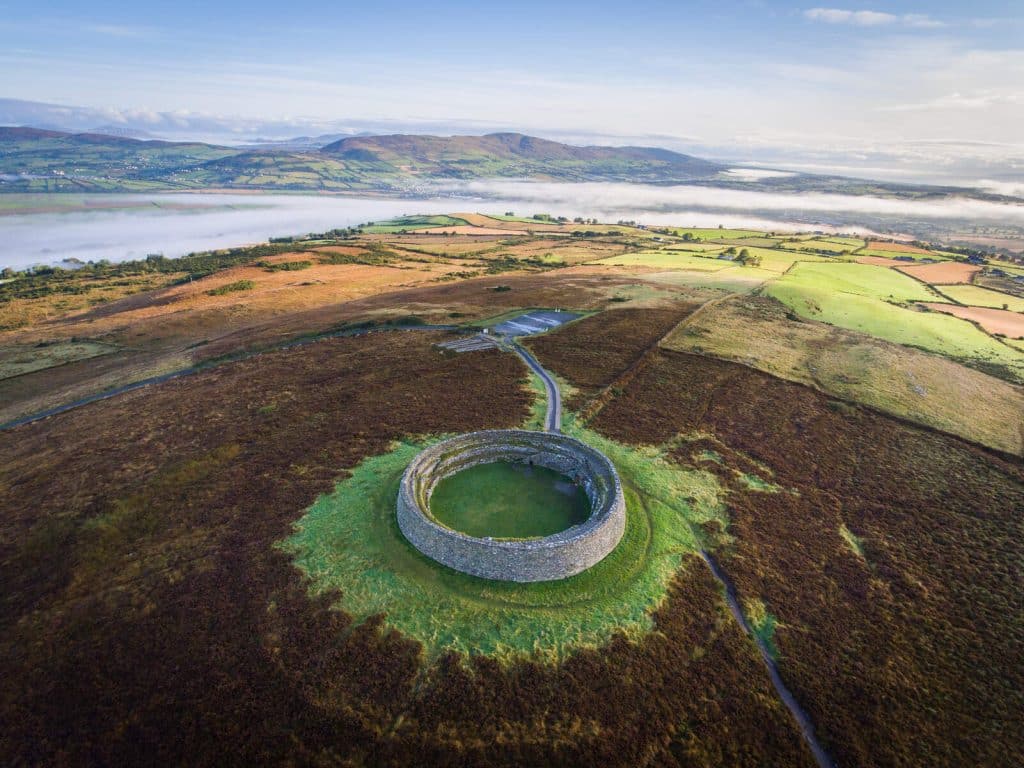
Grianán of Aileach in an Iron Age stone fort. Its origins date all the way back to 1700 BC, built by Tuatha dé Danann, an ancient tribe in Ireland, ruling from 1897 BC to 1700 BC.
The tribe, who existed on the Emerald Isle before the Celts, built a series of stone forts atop strategic hills for defence and protection purposes. It is said that Dagda, the Good God, built Grianán of Aileach as a burial monument to his dead son, Aedh.
Another legend about the stone fort says it was built as a place to worship the sun and a palace of hibernation for Graine, the Celtic Sun Goddess. Other legends say that warriors of the Uí Néill dynasty are buried beneath.
It is believed Prince Eoghan conquered the lands in 395AD, making the stone fort his power base. This led to the name of nearby ‘Inishowen’, meaning ‘Island of Eoghan’.
CELTIC INFLUENCE IN IRELAND: Top 10 most important moments in Celtic history.
How and when to visit – getting to and seeing Grianán of Aileach

You will need a car to visit Grianán of Aileach. It is a mere 27-minute drive from Letterkenny along the N13 in County Donegal. It is an even shorter drive of 20 minutes from Derry City.
If you are travelling from Belfast, leave yourself around an hour and 30 minutes or so, while travelling from the capital, Dublin, will need about three hours and 20 minutes.
There is plenty of parking once you reach the top of the hill, and then a two-minute walk is all that is needed to reach the monument once you’ve parked up.
You can visit Grianán of Aileach year-round. However, we would recommend visiting, if possible, during sunset or sunrise. Here, you will see the beauty which birthed the name of Grianán of Aileach, or the Stone Temple of the Sun.
Address: Carrowreagh, Co. Donegal, Ireland
MAKE THE MOST OF THE CAR: Donegal in five days (an EPIC road trip itinerary).
What to see at Grianán of Aileach – breathtaking views

When you reach Grianán of Aileach, you will be welcomed to an ancient stone fort atop a hill 820 ft (250 m) above sea level. You will witness a stunning, encircling masterpiece that still boasts the outline of Bronze or Iron Age ramparts below the fort.
The dry stones creating the stone fort measure around 76 ft (23 m) in diameter, and the walls are around 16 ft (5 m) high.
When you get to the top of Grianán of Aileach, you will have panoramic, 360-degree views of Lough Foyle and Lough Swilly, which bound the beautiful Inishowen Peninsula in County Donegal.
The green expanse of County Donegal also envelopes you as you reach the summit. When here, take a moment to step back in time and think how the ancient people worshipped, witnessed, and watched from here.
Things to know and what to bring – useful info when visiting Grianán of Aileach

Grianán of Aileach is open all day, every day and has no entry fee. Parking, too, is free.
You can reach the top of the walls thanks to a set of steps. Good walking gear would be advised, and, thanks to typical Donegal and Irish weather, suitable clothing and a raincoat.
Finally, don’t forget to bring a camera to capture the unlimited beauty that awaits you atop the monument.
Contact: +353 7 493 63451 and [email protected]
Website: HERE
Notable mentions

St. Patrick: It is believed that the Irish patron saint, St. Patrick, visited Grianán of Aileach in the fifth century, baptising the local chieftain, Eoghan.
Restoration: Grianán of Aileach was restored in the 1870s by Mr Walter Bernard of Derry, to ensure it remains an ancient masterpiece in the modern day.
Ancient maps: Grianán of Aileach is one of only five Irish locations on Ptolemy of Alexandria’s second-century map of the world.
Your questions answered about Grianán of Aileach
Read our article on Grianán of Aileach but still have some outstanding questions? Then we have you covered! Below, we have put together the most frequently asked questions about this topic from our readers and online searches.

What is the meaning of Grianán of Aileach?
There is one translation of ‘Grianán an Aileach’ which states that it means ‘Stone Temple of the Sun’.
What was Grianán of Aileach used for?
It was built on top of strategic hills by Tuatha dé Danann, who inhabited Ireland before the Celts. It was built as a stone fort to be a burial monument to the deceased son of Dagda, the Good God.
What does the word Grianán mean?
The Irish word ‘Grianán’ means ‘sunny place’. This is what lends credence to the translation of ‘Stone Temple of the Sun’.