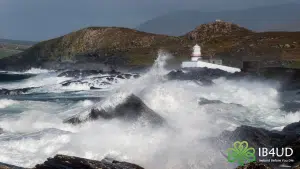
This scenic Irish town on the southern coast is hiding a dark and disturbing past.

For many people Ireland is famous for its beautiful and scenic towns. Places that you will visit and see for a day or a few hours before moving on to the next one. Ireland is full of such places after all, leaving little time for most to see them all, especially during a busy holiday.
However, something is lost through this transaction where one loses out on the unique opportunity to explore and learn about the unique, and often dark, history behind these pretty towns. One of the most startling of which is the town of Kinsale in County Cork.
Plenty has already been said about this famous Irish port town; from the beautiful coloured buildings, its gorgeous beaches, and delightful culinary variety, there are plenty of things to do and see in Kinsale.
But there is plenty of this pretty town’s dark history that has not yet been said. Some of which may surprise you.
Siege of Kinsale & the Spanish Armada – the death of independence

Irish history has no shortage of conflict and strife, with that holding true for the pretty town of Kinsale. This town played a pivotal role in the historical conflict between Britain and Spain over who would control the seas for the centuries to come.
The 1601 Spanish Armada would see 3,500 well-armed Spanish troops on 33 ships sail to Kinsale to create a Catholic front against the British. Storms and other misfortune would see far fewer ships and men arrive, resulting in a gruelling siege of Kinsale that would last for months.
A native relief force led by O’Neill and O’Donnell would attempt to break the siege by attacking the British forces in late 1601. They would not succeed. The Irish forces would be massacred and Kinsale surrendered before the year’s end.
This moment was not only devastating for Kinsale itself, which would bear the marks of the siege for many more years to come; it was also a turning point for an independent Gaelic Ireland, with the infamous Flight of the Earls occurring no later than 1607.
Kinsale & Irish indentured servitude – shipped to Barbados

Few figures in Irish history are as contemptible as Oliver Cromwell. The more one learns about him, the more one sees the bottomless depths of his depravity and crimes against humanity. Such is his involvement in Irish indentured servitude in the New World.
Pretty towns such as Kinsale can make it hard to see the scars a dark history has left them. Rapid population decline and transplantation plagued communities and towns like Kinsale in the years during and after Cromwell’s conquest of Ireland.
Men, women, and children were press-ganged by soldier-thugs into indentured servitude and shipped across the Atlantic to work in perpetuity on plantations. The descendants of these people can be seen today in populations like the Redlegs.
They, like all others who would have been taken forcefully from their homes to become property for another man, are the victims of narratives and propaganda centuries old meant to dehumanise them.
This legacy of racism and discrimination Cromwell was so good at was first practised on the Irish and then perfected with others.
Kinsale & the Great Famine – starvation, imprisonment & disease

Much like the rest of Ireland, Kinsale is not without scars inflicted during the Great Famine. Depending almost entirely on the potato crop, the labouring and working class—almost 80% of the population—would suffer starvation and destitution when the blight struck Ireland.
The most destitute would seek relief in the Kinsale Union Workhouse: a blighted place supposed to provide relief to the beaten and broken. However, this place would serve as little more than a gaol for the 2,000 inhabitants housed within its walls by the end of 1845 alone.
Disease and fever would tear through the population during this time as well. Typhus and “famine fever” would claim many lives, with a deadly cholera outbreak striking the already vulnerable population in 1849.
Between 1847 and 1851, Kinsale’s population would drop by 27%. Kinsale, as elsewhere in Ireland, was ravaged, leaving scars behind in this pretty Irish town.
Kinsale today – beaten but not broken

Despite the tragedy borne throughout its dark history, Kinsale has not only survived all of its hardships, but has indeed found a way to thrive in the modern day.
It is a vibrant and exciting town in Cork, that people all around the world desire to see with their own eyes. It was even recently voted the best place to retire in Europe.
The dark history of Kinsale’s past thankfully does not determine its future, as this pretty Irish town has made the difficult choice of deciding how it wants to be seen and viewed by the world: a place that can heal and grow from the worst events a quiet town like this can experience.