You think graveyards are just eerie? Think again. Some of Ireland’s cemeteries are very atmospheric and are filled with stories.

Visiting graveyards has turned into a bit of niche tourism. Finding the graves of famous people, looking for relatives, or just walking around in silence.
There are several very interesting graveyards in Ireland that hold fascinating stories or give you a story to tell after your visit. We’ll look at the most atmospheric ones.
Glendalough, Co. Wicklow – St. Kevin’s settlement

You might have heard of Glendalough – but did you think it’s a graveyard? Well, it is one.
Glendalough is an old medieval monastic settlement of St. Kevin from the 6th century. Kevin attracted many followers, becoming one of Ireland’s most revered saints.
Walking around Glendalough will leave you in awe. You can still see the impressive round tower, the remains of stone churches, and several graves. The buildings that survive date from the 10th to the 12th century. What these buildings must have seen!
Fun fact: Timber from Glendalough was used to build the second-largest Viking longship.
Address: Glendalough, Bray, Co. Wicklow, A98 HC80, Ireland
Glasnevin, Co. Dublin – Ireland’s most famous graveyard

Glasnevin Cemetery, established in 1832, is Ireland’s largest cemetery. It all started with one grave, 11-year-old Michael Carey from Dublin, who died of TB. Now over 1.5 million people are buried there.
It’s the resting place of famous Irish people like Daniel O’Connell, Michael Collins, Brendan Behan, to name just a few. However, it’s not just famous people there; many ordinary Dubliners are buried in Glasnevin.
Now, is it really a proper cemetery if there’s no spooky story? A dog is said to appear at the grave of Captain Boyd. The dog refused to leave the grave and starved to death.
Address: Finglas Rd, Glasnevin, Dublin, D11 XA32, Ireland
Howard Mausoleum Pyramid, Co. Wicklow – a pyramid in Ireland

Things you wouldn’t expect in Ireland: a pyramid. However, it does exist (and there’s more than one).
The one in County Wicklow is the burial place of the Howard family, built in 1785. Add this to your non-touristy travel list. It’s around 9 metres (30 ft) tall.
There’s room for 33 coffins – which some people sometimes see as a connection to the Freemasons. However, not all the spots have been filled. The pyramid was sealed in 1823, before that, people said they heard a baby’s cries coming from it at night.
Is this perhaps the last body that was added to the mausoleum? It was an infant after all. The cries only stopped after the corpse had been moved.
Address: Old Kilbride Cemetery, Co. Wicklow, Ireland
Derrynane Abbey, Co. Kerry – from a(bbey) to b(each)

You probably didn’t think to add a cemetery to your tour of the Ring of Kerry, but you might just want to.
The graveyard is set in the picturesque ruins of Derrynane Abbey, and it’s close to the home of Daniel O’Connell. In fact, his wife Mary is buried here.
Seeing the view from the cemetery is a story in itself, though: The Abbey is located on a tidal peninsula and overlooks the Atlantic Ocean. It’s only accessible by the beach that is close by. Make sure to check the tide times!
Address: Abbey Island, Co. Kerry, Ireland
Clonmacnoise, Co. Offaly – raided and in ruins
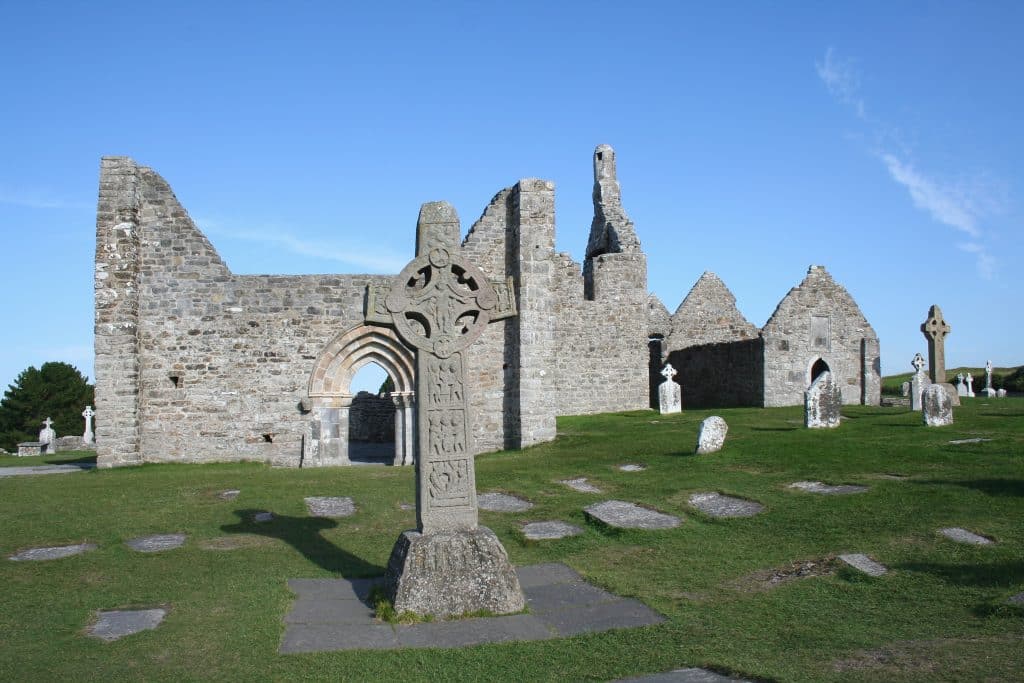
Clonmacnoise is a monastic site from the 6th century. While now mainly ruins, it was once one of the most famous monasteries in Ireland. It was founded by Saint Ciarán, who is buried there – he died of the plague in 549.
For several centuries, Clonmacnoise kept growing. With that growth came several attacks, from the Irish, the Vikings, and the Normans.
The manuscript The Book of Dun Cow was written there, and it’s said that its compiler was murdered in a raid in 1106.
Fun fact: Pope John Paul II stopped in Clonmacnoise on his Ireland tour in 1979.
Address: Clonmacnoise, Co. Offaly, N37 V292, Ireland
St. Columba’s, Co. Sligo – a Nobel winner’s grave

The graveyard of St. Columba’s Church in Drumcliffe may be small, but it is a place of local history and also the last resting place of W. B. Yeats, writer and winner of the Nobel Prize in Literature.
The cemetery and church are set against the backdrop of the Benbulben Mountains that are nearby, giving this place a wonderful view.
Opposite the graveyard, you’ll find Sligo’s only round tower – in the location of the original monastery that was built in 574.
Address: Drumcliffe, Co. Sligo, Ireland
Honourable mention: St. Patrick’s College Graveyard, Co. Kildare – what an entrance

The graveyard honourable mention is part of a university campus: St. Patrick’s College in Maynooth, Co. Kildare. The entrance to the graveyard is lined by trees – giving this small cemetery a very eerie atmosphere.
Address: Collegeland, Maynooth, Co. Kildare, Ireland
There are many more stories to be found in all of these cemeteries. Combined with their special atmosphere, they’re all certainly worth a trip. Which one will you go and visit first?